

Towards Understanding Deep Classifiers though Neural Collapse
 Towards Understanding Deep Classifiers though Neural Collapse Towards Understanding Deep Classifiers though Neural Collapse
  Towards Understanding the Implicit Regularization Effect of SGD
 This event has been cancelled.
Kelsey Allen is a Senior Research Scientist at Deepmind. Her work surrounds cognitive science, machine learning, and robotics, with a focus on tool use and tool creation.
Organizer: Kathleen Sullivan Organizer Email: cbmm-contact@mit.eduAbstract: Modern machine learning models, in particular large language models, are approaching and even surpassing human-level performance at various benchmarks. In this talk, I will discuss the possibilities and barriers towards achieving human-level intelligence from a computational learning theory perspective. Specifically, I will talk about how auto-regressive next-token predictors can learn to solve computationally complex tasks. Additionally, I will discuss how generative models can “transcend” their training data, outperforming the experts that generate their data, with specific focus on learning to play chess from game transcripts.
Organizer: Kathleen Sullivan Organizer Email: cbmm-contact@mit.eduNoah Goodman is a Professor of Psychology and Computer Science at Stanford University. His research surrounds computational models of cognition, cognitive development and social cognition, and probabilistic programming languages.
Organizer Email: cbmm-contact@mit.eduAbstract: Supervised learning is the problem of estimating a function from input and output samples. But how many samples are needed to achieve a prescribed accuracy?
This question can be answered only by restricting the class of problems—for example, considering functions that don’t vary much. But in even this case, we find that the number of needed samples depends exponentially on the dimensions of each input—the so-called curse of dimensionality.
Since neural nets seem to learn well with much less data, it is natural to postulate that the underlying problems (functions) have more structure beyond bounded variations. The search for the right notion of “structure” has been quite elusive thus far, and I will discuss some recent results that emphasize the role of sparsity and compositions.
Bio: Lorenzo Rosasco is a professor at the University of Genova, a research affiliate at MIT, and a visiting scientist at the Italian Technological Institute (IIT). He is a founder and coordinator of the Machine Learning Genova center (MaLGa) and the Laboratory for Computational and Statistical Learning, focusing on the theory, algorithms, and applications of machine learning. He obtained his PhD in 2006 from the University of Genova and was a visiting student at the Center for Biological and Computational Learning at MIT, the Toyota Technological Institute at Chicago (TTI-Chicago), and the Johann Radon Institute for Computational and Applied Mathematics. From 2006 to 2013, he worked as a postdoc and research scientist at the Brain and Cognitive Sciences Department at MIT. He is a fellow at Ellis and serves as the co-director of the "Theory, Algorithms and Computations of Modern Learning Systems" program as well as the Ellis Genoa unit. Lorenzo has received several awards, including an ERC consolidator grant.
Organizer: Kathleen Sullivan Organizer Email: cbmm-contact@mit.eduAbstract: It is immensely empowering to delegate information processing work to machines and have them carry out difficult tasks on our behalf. But programming computers is hard. The traditional approach to this problem is to try to fix people: They should work harder to learn to code. In this talk, I argue that a promising alternative is to meet people partway. Specifically, powerful new approaches to machine learning provide ways to infer intent from disparate signals and could help make it easier for everyone to get computational help with their vexing problems.
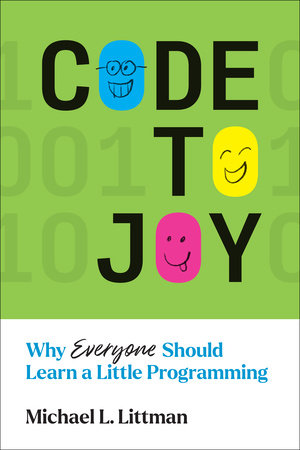
Bio: Michael L. Littman, Ph.D. is a Professor of Computer Science at Brown University and Division Director of Information and Intelligent Systems at the National Science Foundation. He studies machine learning and decision-making under uncertainty and has earned multiple awards for his teaching and research. Littman has chaired major conferences in A.I. and machine learning and is a Fellow of both the Association for the Advancement of Artificial Intelligence and the Association for Computing Machinery. He was selected by the American Association for the Advancement of Science as a Leadership Fellow for Public Engagement with Science in Artificial Intelligence, has a popular YouTube channel and appeared in a national TV commercial in 2016. His book, "Code to Joy: Why Everyone Should Learn a Little Programming" was published in October 2023 by MIT Press.
Organizer: Hector Penagos Organizer Email: cbmm-contact@mit.edu SGD and Weight Decay Secretly Compress Your Neural Network