CBMM Postdoc Meeting: Measuring object detection performance at scale in humans and machines

Jan 13, 2016 - 3:00 pm
Images from the ImageNet classification task
Venue:  MIT, Bldg. 46 Room 5193 Address:  5th Floor, MIT Bldg 46, 43 Vassar Street, Cambridge MA 02139

Discussing the limitations of current object detection tasks, evaluations and datasets and trying to suggest alternatives aligned with the goals of CBMM. The aim is to propose and formulate frameworks through CBMM for datasets, tasks, metrics, evaluation strategies etc.

Organizer:  Andrei Barbu Georgios Evangelopoulos

CBMM Postdoc Meeting: Measuring object detection performance at scale in humans and machines (II)

Dec 2, 2015 - 3:30 pm
Venue:  Harvard Northwest Building Room 255 Address:  52 Oxford St Cambridge, MA 02138

Topic: "Measuring object detection performance at scale in humans and machines" (cont.)
Wed. Dec. 02, 2015, 3:30 pm - 4:30 pm
Location: Harvard, NW-255

Brainstorming on the limitations of tasks and evaluations regarding object detection. The topic is very relevant to CBMM and the hope is to have a practical proposal coming out of these discussions. 

(Note we'll start later than usual to align with the main meeting that will start 4:30).


Organizer:  Georgios Evangelopoulos Andrei Barbu

Brains, Minds and Machines Workshop | Sestri Levante

Jun 20, 2016 - 9:00 am
Photo of Sestri Levante, Italy
Venue:  Sestri Levante, Italy
June 20-22, 2016 (Tentative) | Sestri Levante, Italy

The Center for Brains, Minds and Machines, the Italian Institute for Technology, and the Max Planck Institute for Biological Cybernetics are organizing a workshop on the science and engineering of intelligence on June 20-22, 2016 in Sestri Levante, Italy.  For three days -- one day for each of the Brains, Minds, and Machines areas -- we will bring together computer scientists/roboticists, cognitive scientists, and neuroscientists to share and discuss advances in integrated, multimodal approaches to the study of human intelligence.

Organizers: Boris Katz (MIT), Giorgio Metta (Istituto Italiano di Tecnologia) and Lorenzo Rosasco (University of Genova)

Local Organizer: Fabio Anselmi (Istituto Italiano di Tecnologia)

Steering Committee: Tomaso Poggio (MIT), Heinrich H. Bülthoff (Max Planck), Tony Prescott (University of Sheffield), Josh Tenenbaum (MIT)
 

Workshop website: http://cbmm.mit.edu/bmm-workshop-sestri


Organizer:  Boris Katz Giorgo Metta

CBMM Research Meeting

Jan 27, 2016 - 4:00 pm
Venue:  Harvard U. Northwest Bldg. Room 243 Address:  52 Oxford St., Cambridge, MA 02138 Speaker/s:  Nancy Kanwisher

Thrust 4 Projects

Speakers: Prof. Nancy Kanwisher - Introduction; Matt Peterson - "Real World Eye Movements for Acquiring Social Information"; Maryam Vaziri Pashkam - "Understanding action reading and social vision from simple interactions"; Leyla Isik - "Studying social interactions with commercial movie stimuli"

CBMM Weekly Research Meeting

Jan 13, 2016 - 4:00 pm
Venue:  MIT Bldg. 46 Room TBA Speaker/s:  Tomaso Poggio, Qianli Liao, Georgios Evangelopoulos, and Tejas Kulkarni.

Thrust 5: Theories of Intelligence 

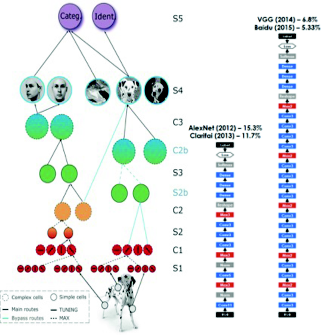
The thrust aims to provide theoretical frameworks and common mathematical tools for understanding visual intelligence, for guiding computer implementations, and for informing and interpreting experiments in the Center.

Our working hypothesis for vision suggests two main different stages of visual processing:

  • The first 100ms of vision in the ventral stream are mostly feedforward and correspond to what we may call immediate perception (following Julesz). We conjecture that the main computational goal is to generate image representations that can be used to answer different types of basic questions. Our theoretical framework  to describe feedforward processing in the hierarchy of cortical areas is i-theory.
  • More specific, task-dependent questions require different computations that involve top-down, possibly iterative processing. We are working on two theoretical frameworks  to deal with this stage: generative models&probabilistic inference and  top-down visual routines.

We will give a brief overview of the state of Thrust 5, followed by flash-like presentations of three projects:

  1. application of i-theory to the face network in macaque brain
  2. application of i-theory to speech
  3. examples of models based on the probabilistic/generative framework

We will then open an informal discussion around the approach, its problems and its many open questions.

CBMM Weekly Research Meeting

Dec 16, 2015 - 4:30 pm
Tangetal
Venue:  MIT Bldg. 46 Room 5165 Address:  5th Floor, MIT Bldg 46, 43 Vassar St., Cambridge MA 02139 Speaker/s:  Gabriel Kreiman

Thrust 2 Projects

Hanlin Tang and Bill Lotter - Pattern completion: behavior, physiology and computation

Matt Wilson - Presentation of the Penagos-Gershman research collaboration

Ed Boyden: Technologies for Mapping the Circuits and Mechanisms of Intelligence

Please note change in start time, this meeting will start at 4:30pm.

CBMM Weekly Research Meeting: Imaginative Reinforcement Learning

Nov 18, 2015 - 4:00 pm
CBMM logo
Venue:  MIT McGovern Institute for Brain Research (MIT Bldg 46) Address:  43 Vassar St., Cambridge MA 02139 MIT Bldg 46, 5th Floor, MIBR Reading Room #46-5165 Speaker/s:  Sam Gershman  

Abstract: Reinforcement learning is typically conceived of in terms of how reward predictions and choice behavior adapt based on an agent's experience. However, experience is too limited to provide the brain with the knowledge necessary for adaptive behavior in the real world. To go beyond experience, the brain must harness its imaginative powers. Applications of imagination to reinforcement learning include prospective simulation for planning, and learning cached values from imaginative episodes. I will discuss how these ideas can be formalized, recent experimental evidence, and connections to other ideas being explored in CBMM.

Gershman Lab website: http://gershmanlab.webfactional.com/index.html

NIPS 2015 Workshop on Black Box Learning and Inference

Dec 12, 2015 - 8:30 am
Image for NIPS 2015 Workshop on Black Box Learning and Inference
Venue:  Palais des congrès de Montréal, Montreal, Canada Address:  1001 Place Jean-Paul-Riopelle, Montréal, QC H2Z 1H5, Canada

Prof. Joshua Tenenbaum (CBMM Research Thrust Leader) and Tejas Kulkarni (CBMM Siemens Graduate Fellow) are helping to organize the NIPS 2015 Workshop on Black Box Learning and Inference.


Overview

Probabilistic models have traditionally co-evolved with tailored algorithms for efficient learning and inference. One of the exciting developments of recent years has been the resurgence of black box methods, which make relatively few assumptions about the model structure, allowing application to broader model families.

In probabilistic programming systems, black box methods have greatly improved the capabilities of inference back ends. Similarly, the design of connectionist models has been simplified by the development of black box frameworks for training arbitrary architectures. These innovations open up opportunities to design new classes of models that smoothly negotiate the transition from low-level features of the data to high-level structured representations that are interpretable and generalize well across examples.

This workshop brings together developers of black box inference technologies, probabilistic programming systems, and connectionist computing frameworks. The goal is to formulate a shared understanding of how black box methods can enable advances in the design of intelligent learning systems. Topics of discussion will include:

  • Black box techniques for gradient ascent, variational inference, Markov chain- and sequential Monte Carlo.
  • Implementation of black box techniques in probabilistic programming systems and computing frameworks for connectionist model families.
  • Models that integrate top-down and bottom-up model representations to perform amortized inference: variational autoencoders, deep latent Gaussian models, restricted Boltzmann machines, neural network based proposals in MCMC.
  • Applications to vision, speech, reinforcement learning, motor control, language learning.

Keynote talks

  • Josh Tenenbaum
  • Geoff Hinton

Research talks

  • Durk Kingma
  • Alp Kucukelbir
  • Jan-Willem van de Meent

Systems spotlights

  • Koray Kavukcuoglu (Torch)
  • Alp Kucukelbir (Stan)
  • Yi Wu (BLOG)
  • Avi Pfeffer (Figaro)
  • Vikash Mansinghka (Venture)
  • Tejas Kulkarni (Picture)

Organizers

News Link: http://www.blackboxworkshop.org/

Organizer:  Joshua Tenenbaum Tejas Dattatraya Kulkarni
NIPS 2015 Workshop on Bounded Optimality and Rational Metareasoning

Dec 11, 2015 - 8:30 am
Nips
Venue:  Palais des congrès de Montréal, Montreal, Canada Address:  Montreal Convention Center, Room 512bf 1001 Place Jean-Paul-Riopelle, Montréal, QC H2Z 1H5, Canada

Prof. Sam Gershman (CBMM, Harvard) and Prof Noah Goodman (CBMM, Stanford)

We are pleased to announce a NIPS workshop on Bounded Optimality and Rational Metareasoning, which will take place on December 11, 2015, in Montreal, Canada.

This workshop brings together computer scientists working on bounded optimality and metareasoning with psychologists and neuroscientists reverse-engineering the computational principles that make the human brain incredibly resource-efficient. The goal of this workshop is to synthesize these different perspectives on bounded optimality, to promote interdisciplinary interactions and cross-fertilization, and to identify directions for future research.

Tentative schedule: https://sites.google.com/site/boundedoptimalityworkshop/home 

Organizer:  Samuel Gershman Noah Goodman

Pages

Subscribe to Front page feed