No

CBMM Postdoc Group Meeting

May 16, 2014 - 3:00 pm
Venue:  MIT: McGovern Institute Seminar Room, 46-5193 Address:  43 Vassar Street, MIT Bldg 46, Cambridge, MA 02139 United States

Meeting Notes:

  • Extend the CBMM postdoc group meetings to include also CBMM graduate students. The consensus was that CBMM graduate students are welcome to attend the meetings. The general agenda of the group meetings will still focus mainly on postdoc-related interests such as research activities, teaching and training, and career development.
  • Construct a complementary CBMM graduate students mailing-list.
  • Conclude the presentations of all postdoc members in upcoming meetings.
  • Invite postdoc members to give training sessions on topics of their expertise that might interest the group.
  • Encourage follow-up meetings between CBMM postdocs and GE Analytics researchers.

CBMM Weekly Research Meeting: Ongoing fMRI Investigations of Social Perception in the STS

May 9, 2014 - 4:00 pm
Venue:  MIT: McGovern Institute Reading Room, 46-5165 Address:  43 Vassar Street, MIT Bldg 46 , Cambridge, MA 02139 United States Speaker/s:  Ben Deen

Collaborator: Nancy Kanwisher, Rebecca Saxe; CBMM Thrust 4 – Social Intelligence

Progress of CBMM Challenge – Social Intelligence

Abstract:

The central aim of Thrust 4 is to understand nonverbal social perception, or the ability to make high-level social inferences from perceptual information, in order to allow the development of models able to answer CBMM challenge questions about people and their social interactions from images and videos. The study of social perception is in its relative infancy: we have a catalog of intriguing behavioral findings on what sorts of inferences can be made, but don’t have a sense of the full scope of these abilities, nor any understanding of their computational basis or neural implementation.

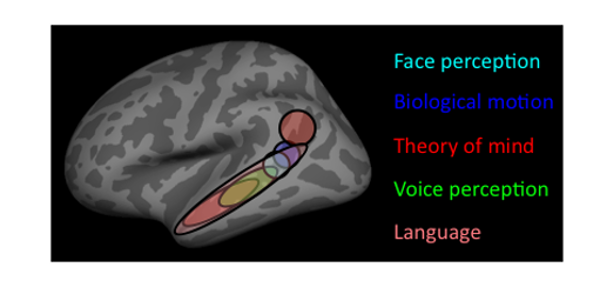
Here, we propose to investigate the functional organization of the neural machinery for social perception as a first step toward understanding the computational and neural architecture of these abilities.  Specifically, we target the superior temporal sulcus, which has been argued to play a role in a large number of social perceptual and cognitive processes: the perception of faces, biological motion, and voices, as well as the ability to understand language and mental state content.

In experiment 1, we use fMRI to measure STS responses during a number of different social perceptual tasks, and compare responses within individual participants.  We find that the STS has a strong spatial organization, with distinct processes eliciting distinct patterns of activity.  Furthermore, we find both evidence for selective STS subregions, which respond strongly to one task and not others, and multifunctional regions in which responses to multiple tasks overlap.

In experiment 2 we further investigate a particularly strong case of overlap from experiment 1 – overlap between responses to dynamic faces and vocal sounds. […]

CBMM Weekly Research Meeting: Progress of CBMM Challenge – Development of Intelligence

May 2, 2014 - 4:00 pm
Venue:  Harvard University: Northwest Bldg, Room 243 Address:  52 Oxford Street, Harvard University Northwest Building, Cambridge, 02138 Speaker/s:  Noah Goodman; CBMM Thrust 1 – Development of Intelligence

Progress on the CBMM Challenge Questions: What is there? and Who is there?

Abstract:

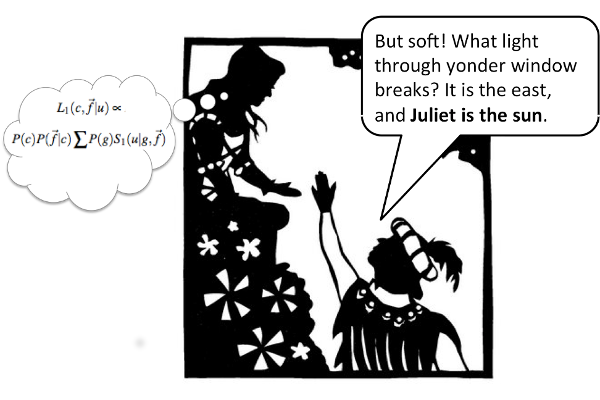
Thrust 1 presents this week episode in our series of weekly discussions on progress on the CBMM challenge questions. The thrust is focused on the development of intelligence and on how to model it. It is therefore appropriate to step back and ask: what role do compositionality, probabilistic inference, and intuitive theories have to play in our understanding of understanding? Noah Goodman will start by discussing the Probabilistic Language of Thought hypothesis, including taking a quick tour of the web book probmods.org and the models repository forested.org. Noah will then ask how language interfaces with non-linguistic understanding, and how context mediates this interaction, sketching an architecture for natural language semantics and pragmatics, grounded in probabilistic intuitive theories. Noah plans to extend the basic architecture to figurative language, such as hyperbole, and argue that compositionality of thought it central but deeply buried in everyday language. This will be the motivation to ask what formal semantics and pragmatic effects we may need to engage with even for the (mostly non-linguistic) CBMM challenge.

CBMM Weekly Research Meeting – Top-down Control of Attention

Apr 25, 2014 - 4:00 pm
Top-down Control of Attention
Venue:  MIT: McGovern Institute Seminar Room, 46-3189 Address:  43 Vassar Street, MIT Bldg 46, Cambridge, MA 02139 United States Speaker/s:  Robert Desimone; Thrust 2 – Circuits for Intelligence and Thrust 5 – Theories of Intelligence

Progress on the CBMM challenge questions: What/Who is there?

Abstract:

We continue the series of weekly discussions and reports on each CBMM challenge question describing progress and problems of ongoing work at CBMM.

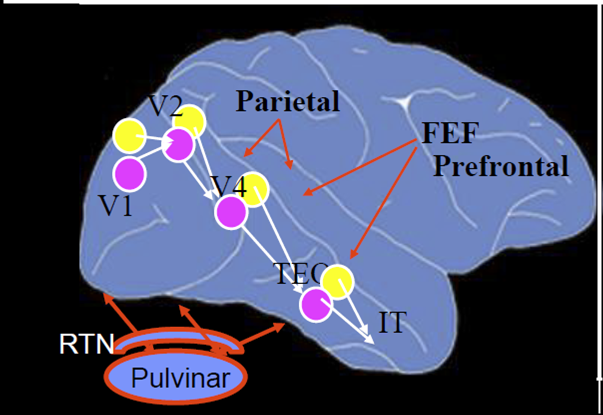
Thrust 2 is focused on the Neural Circuits and on how models for the CBMM challenge should be consistent with the brain neural data. One of the projects in the thrust focuses on the neural correlates of visual attention, which plays a key role in the answer to most of the CBMM open set of questions, probably in the form of task-dependent visual routines. I will describe very recent results about the neural correlates of so-called object attention. The voluntary control of visual attention to behaviorally relevant stimuli is thought to involve “top-down” feedback to visual processing areas. For spatially-directed attention, one key source of top-down attention is the frontal eye fields (FEF). My lab found that feedback to visual cortex from FEF causes enhanced responses to stimuli at attended locations, and leads to synchronized neural activity in the gamma frequency range between FEF and visual processing areas. Recent evidence suggests that the pulvinar may also serve as an important relay of attentional feedback to visual cortex, and it may also serve to desynchronize cortical activity in the alpha frequency range. Many aspects of the neural response changes with attention are explained by top-down inputs to a simple cortical circuit containing excitatory and inhibitory neurons. The neural basis of feature, or object attention has been much more difficult to understand.

One possibility is that attention to objects with particular features causes spatially directed attention to be directed to those objects, utilizing known pathways for spatial attention. Another possibility is that attention to objects or features such as faces, colors, or shapes, depends on feedback to visual cells that are selective for those features, biasing activity in favor of those stimuli. Such a mechanism would be similar to what is thought to mediate visual recall memory. We have recently found evidence for both types of mechanisms in prefrontal cortex of humans and monkeys.

CBMM Postdoc Group Meeting: GE-Analytics Collaboration Event

Apr 25, 2014 - 11:00 am
Venue:  MIT: McGovern Institute Reading Room, 46-5165 Address:  43 Vassar Street, MIT Bldg 46 , Cambridge, MA 02139 United States

The CBMM Postdoc Group meeting will be hosted at MIT.  This week we will have a special event and collaborate with members of the GE-Analytics Team.

Summary:

Special collaboration meeting with researchers from GE Analytics.

There were 38 participants, 9 from GE and 29 CBMM postdocs, grad-students and PI’s.

Specifically, 75% of the CBMM postdoc group members attended this meeting. A similar number of CBMM graduate students have also attended and participated.

This meeting lasted 5 hours following this schedule:

11:00-12:00pm:    Presentations: Overview of the CBMM and research projects at GE

12:00-1:00pm:      Lunch

1:00-2:00pm:        Smaller interactive sessions GE presentation

2:00-3:00pm:       Smaller interactive sessions CBMM/MIT presentations

3:00-4:00pm:       Additional discussions

With the goal of creating interactive dialog and building collaborations, Mark Grabb, Rahul Bhotika and GE researchers from the analytics and healthcare groups, first presented briefly their work in visual intelligence, image analysis, anomaly detection, robotics and collaborative agents, knowledge modeling, and neuroscience, in order to provide an overview sample of topics and associate them with the relevant GE representative.

Prof. Matthew Wilson presented an overview of the CBMM mission, goals and possible relations to research and development in general.

The second part of the meeting consisted of parallel comprehensive research presentations in small groups of 3-5. During this part, the GE researchers have introduced and discussed, with postdocs and students, open industrial analytics problems that can benefit from approaches in artificial intelligence, cognitive science, and computational neuroscience. They provided technical details on how different problems are approached, along with insights on how research is conceptualized, funded and performed on a non-academic research facility.

In the third part, some CBMM postdocs and students presented their research to GE representatives in small groups, and discussed common research interests as well as relevant industrial research tools and data. Different theoretical and applied research topics were presented, related to research objectives in the CBMM thrusts.

In summary, this meeting provided means for postdocs and students to learn more about real-world and industrial research projects, and the transfer of knowledge and technology from a research lab to production. This meeting also provided means for GE and CBMM participants to learn about the academic research projects and active research areas within CBMM, and consider possible collaborations to leverage from combining advanced research approaches with top industrial development  tools and  data for real-life applications.

Both parties agreed there should be a follow-up to enable future research discussions and collaborations. The CBMM postdoc group will revisit many of the issues mentioned, along with relevant career opportunities in one of the future research meetings.

CBMM Weekly Research Meeting: Progress of CBMM Challenge – Theories of Intelligence

Apr 18, 2014 - 4:00 pm
Venue:  Harvard University: Northwest Bldg, Room 243 Address:  52 Oxford Street, Harvard University Northwest Building, Cambridge, 02138 Speaker/s:  Winrich Freiwald and Joel Z. Leibo; CBMM Thrust 5 – Theories for Intelligence

Title: On the neural mechanisms of face recognition: from experiments to theory

Abstract:

Object recognition, the ability to identify an object despite vast changes in appearance due to changes in lighting or orientation, is a major accomplishment of the primate brain, as a result of which we can recognize objects with an ease belying the daunting complexity of the computational challenges involved. Understanding not only the algorithms used to answer the questions What is there? Who is there?, but also the underlying neural mechanisms  is a major problem for both the experimental and the theoretical neurosciences – and one of the main items in the CBMM challenge. To decipher the mechanisms of object recognition, we have taken advantage of a unique model system evolution has provided us with. The temporal lobes of macaque monkeys, like those of humans, contain neural machinery to support face recognition. The machinery consists of a fixed number of discrete patches of face-selective cortex that can be localized with functional magnetic brain resonance imaging. The three main organizing features of this system, concentration of cells encoding the same complex object category into modules, spatial separation of modules with different functional roles for face processing, and integration of modules into an interconnected network, make it possible to break down the process of face recognition into its components. In this talk, we will present the experimental data we have obtained over the last years that characterize the major properties of this system. In particular, we will discuss results showing that a mirror symmetric face representation is computed as an intermediate step between view-tuned and view-tolerant representations. In the second part of the talk we will describe how this finding was influential in the early conception and development of M-theory, currently one of the research directions in the CBMM. We will describe and discuss a computational model of the face-processing system that is derived from M-theory and predicts and explains the core experimental finding.  This interdisciplinary project on the neural mechanisms for the processing of a stimulus set of utmost relevance for social cognition, bridges activities between three Thrusts of the CBMM.

CBMM Weekly Research Meeting: What can mice tell us about visual intelligence?

Apr 11, 2014 - 4:00 pm
Alignment example
Venue:  MIT: McGovern Institute Reading Room, 46-5165 Address:  43 Vassar Street, MIT Bldg 46 , Cambridge, MA 02139 United States Speaker/s:  Dr. Michael Buice, Allen Institute for Brain Science, CBMM Thrust 2: Circuits for Intelligence and Thrust 5: Theories for Intelligence

Progress on the CBMM challenge questions: What/Who is there?

Abstract:
In the Jeopardy/Watson effort every week on Friday there was an evaluation of performance. We continue the series of weekly discussions and reports on each CBMM challenge question [e.g. What is there? What will happen next? What are they doing? etc.] describing progress and problems of ongoing work at CBMM.

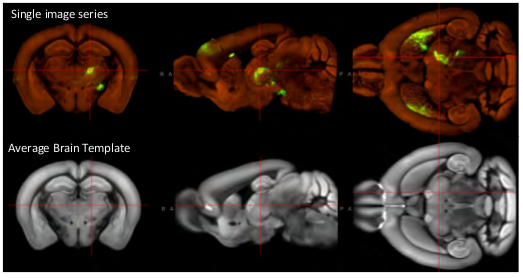
The Allen Institute for Brain Science uses a big science approach to neuroscience, integrating experiment, modeling and theory. One of the Institute’s projects, MindScope, is an exploration of the mouse visual system from a multitude of coordinated approaches. I will give an overview of the MindScope project and the “C3” approach – Components, Computation, and Cognition, and discuss how the goals of MindScope relate to the goals of CBMM. Important goals along our Cognition axis are Object Recognition, Attention, and Decision Making in the mouse cortico-thalamic system. The M-Theory framework provides a feedforward architecture which computes invariant representations of the visual field, facilitating fast object recognition which mimics human performance on recognition tasks within about 100ms. Several results suggest that recognition beyond 100ms or so involves feedback. I will discuss some preliminary ideas on extending the M-Theory framework to include feedback, in particular by incorporating elements of probabilistic inference into the model.

CBMM Weekly Research Meeting: Computing scale and translation invariant representations requires an eccentricity-dependent cortical magnification factor.

Apr 4, 2014 - 4:00 pm
Venue:  Harvard University: Northwest Bldg, Room 243 Address:  52 Oxford Street, Harvard University Northwest Building, Cambridge, 02138 Speaker/s:  Tomaso Poggio and Jim Mutch; CBMM Thrust 5 – Theories for Intelligence

Progress of CBMM Challenge – Enabling Theory

Abstract:

We continue the series of weekly discussions and reports on each CBMM challenge question [e.g. What is there? What will happen next? What are they doing? etc.] describing progress and problems of ongoing work at CBMM.

This Friday we will speak informally about very preliminary work with the explicit goal of brainstorming about where to go. Basic properties of recognition at a glance are predicted by a sampling for magic theory. The emerging picture is consistent with Ullman’s ideas on minimal images and implies that recognition under natural conditions happens by composing information from a set of fixations, with each fixation providing recognition from image patches of about arrays of 30 by 30 pixels at different resolutions.
According to the magic theory, invariance to scale and translation predicts an architecture of visual cortex that is consistent with the data about cortical magnification factor. Our sampling extension of the theory suggests a size of minimal images of around 30 by 30, a fovea of size around 20’ at the highest resolution and translation invariance that depend linearly on spatial frequency.

Presenters hope there will be discussions on topics such as:
• Which psychophysical experiment should be done to clarify the current confusing literature on translation invariance in recognition?
• Can we predict crowding and Bouma’s law?
• Can we predict the cortical location of different recognition tasks?

Pages

Subscribe to No