


Stability of overparametrized learning models
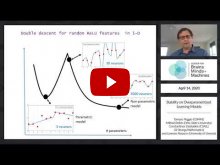 Stability of overparametrized learning models Stability of overparametrized learning models
 Abstract:
Spatial perception has witnessed an unprecedented progress in the last decade. Robots are now able to detect objects and create large-scale maps of an unknown environment, which are crucial capabilities for navigation and manipulation. Despite these advances, both researchers and practitioners are well aware of the brittleness of current perception systems, and a large gap still separates robot and human perception. While many applications can afford occasional failures (e.g., AR/VR, domestic robotics) or can structure the environment to simplify perception (e.g., industrial robotics), safety-critical applications of robotics in the wild, ranging from self-driving vehicles to search & rescue, demand a new generation of algorithms.
This talk discusses two efforts targeted at bridging this gap. The first focuses on robustness. I present recent advances in the design of certifiable perception algorithms that are robust to extreme amounts of outliers and afford performance guarantees. I present fast certifiable algorithms for object pose estimation in 3D point clouds and RGB images: our algorithms are “hard to break” (e.g., are robust to 99% outliers) and succeed in localizing objects where an average human would fail. Moreover, they come with a “contract” that guarantees their input-output performance. I discuss the foundations of certifiable perception and motivate how these foundations can lead to safer systems, while circumventing the intrinsic computational intractability of typical perception problems.
The second effort targets high-level understanding. While humans are able to quickly grasp both geometric and semantic aspects of a scene, high-level scene understanding remains a challenge for robotics. I present our recent work on actionable hierarchical representations, 3D Dynamic Scene Graphs, and discuss their potential impact on planning and decision-making, human-robot interaction, long-term autonomy, and scene prediction. The creation of a Dynamic Scene Graph requires a variety of algorithms, ranging from model-based estimation to deep learning, and offers new opportunities for both researchers and practitioners.
Bio:
Luca Carlone is the Charles Stark Draper Assistant Professor in the Department of Aeronautics and Astronautics at the Massachusetts Institute of Technology, and a Principal Investigator in the Laboratory for Information & Decision Systems (LIDS). He received his PhD from the Polytechnic University of Turin in 2012. He joined LIDS as a postdoctoral associate (2015) and later as a Research Scientist (2016), after spending two years as a postdoctoral fellow at the Georgia Institute of Technology (2013-2015). His research interests include nonlinear estimation, numerical and distributed optimization, and probabilistic inference, applied to sensing, perception, and decision-making in single and multi-robot systems. His work includes seminal results on certifiably correct algorithms for localization and mapping, as well as approaches for visual-inertial navigation and distributed mapping. He is a recipient of the 2017 Transactions on Robotics King-Sun Fu Memorial Best Paper Award, the best paper award at WAFR’16, the best Student paper award at the 2018 Symposium on VLSI Circuits, and he was best paper finalist at RSS’15. At MIT, he teaches “Robotics: Science and Systems,” the introduction to robotics for MIT undergraduates, and he created the graduate-level course “Visual Navigation for Autonomous Vehicles”, which covers mathematical foundations and fast C++ implementations of spatial perception algorithms for drones and autonomous vehicles.
Connect to the Webinar using this link: https://mit.zoom.us/j/95924561648
Organizer: Hector Penagos Organizer Email: cbmm-contact@mit.edu
Abstract:
Developing theoretical foundations for learning is a key step towards understanding intelligence. Supervised learning is a paradigm in which natural or artificial networks learn a functional relationship from a set of n input-output training examples. A main challenge for the theory is to determine conditions under which a learning algorithm will be able to predict well on new inputs after training on a finite training set, i.e. generalization. In classical learning theory, this was accomplished by appropriately restricting the space of functions represented by the networks (the hypothesis space), characterizing a regime in which the number of training examples (n) is greater than the number of parameters to be learned (d). Here we will discuss the regime in which networks remain overparametrized, i.e. d > n as n grows, and in which the hypothesis space is not fixed. Our panel discussion will center on key stability properties of general algorithms, rather than the hypothesis space, that are necessary to achieve learnability.
Join Zoom Meeting
https://mit.zoom.us/j/603597866
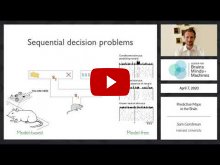 Predictive Maps in the Brain
Abstract: In this talk, I will present a theory of reinforcement learning that falls in between "model-based" and "model-free" approaches. The key idea is to represent a "predictive map" of the environment, which can then be used to efficiently compute values. I show how such a map explains many aspects of the hippocampal representation of space, and the map's eigendecomposition reveals latent structure resembling entorhinal grid cells. I will then present evidence, using a novel revaluation task, that humans employ such a predictive map to solve reinforcement learning tasks. Finally, I will discuss the role of dopamine error signals in learning the predictive map.
Link to Meeting: https://harvard.zoom.us/j/301130600
Organizer: Jean Lawrence Hector Penagos Organizer Email: cbmm-contact@mit.edu Can we Contain Covid-19 without Locking-down the Economy?