No

MIT IAP 2016: Opening Up Your Research to the Web
Jan 11, 2016 - 12:00 am
MIT Independent Activities Period (IAP) logo

Greg Hale (CBMM Application Developer) will be leading two activities during MIT IAP 2016. Everyone in the CBMM community is invited to attend.


Do you have a dataset that you want to share, an algorithm that predicts diseases from gene mutations, or a neat way to visualize data? Maybe these things want to live and work on the internet. Bring your ideas, and we will look at (maybe even implement!) some of the tools for crossing the chasm from screenshots of your local solution to a working resource the whole world could use.

Topics will depend on the interests of people in the course. We may look at building and hosting web pages, sharing small or large datasets, Amazon Web Services, interactive svg figures in web pages, and writing public API servers. The focus will be on doing these things without too much disruption to your normal research routine, and on building the confidence to go further in your own explorations
in web development.

Instructor: Greg Hale, Applications/Technical Specialist
Enrollment: Limited: First come, first served (no advance sign-up)
Prereq: N/A
Attendance: Participants welcome at individual sessions
Meeting time/length: Jan 11-15; from 3-4:30pm
Location: McGovern Reading Room # 46-5165, 5th Floor of MIT Bldg. 46, 43 Vassar St., Cambridge MA 02139
Sponsor(s): Brain and Cognitive Sciences
Contact: Greg Hale, 46-5169, email: greghale at mit.edu

Link to MIT IAP listing: http://student.mit.edu/searchiap/iap-9289af8f51100344015126e75301021d.html


See MIT Registrar website for MIT Cross-registration Instructions for Harvard Students: http://web.mit.edu/registrar/reg/xreg/HarvardtoMIT.html

The Independent Activities Period (IAP) is a special term at MIT that runs from early January until the end of the month. IAP 2013 will run from Monday, January 7 through Friday, February 1, 2013.

IAP provides members of the MIT community (students, faculty, staff, and alums) with a unique opportunity to organize, sponsor and participate in a wide variety of activities, including how-to sessions, forums, athletic endeavors, lecture series, films, tours, recitals and contests.
 

Responsible Conduct in Science - MIT IAP Course 9.901

Photo of microscope
Massachusetts Institute of Technology (MIT)
Instructor(s): 
Course will be held the January 10-14, M-F, from 2-5pm, Virtual Class Provides instruction and dialogue on practical ethical issues relating to the responsible conduct of human and animal research in the brain and cognitive sciences. Specific emphasis on topics relevant to young researchers including data handling, animal and human subjects, misconduct, mentoring, intellectual property, and publication. Preliminary assigned readings and initial faculty lecture followed by discussion groups of four to five students each. A short written summary of the discussions submitted at the end of each class. See IAP Guide for registration information. 


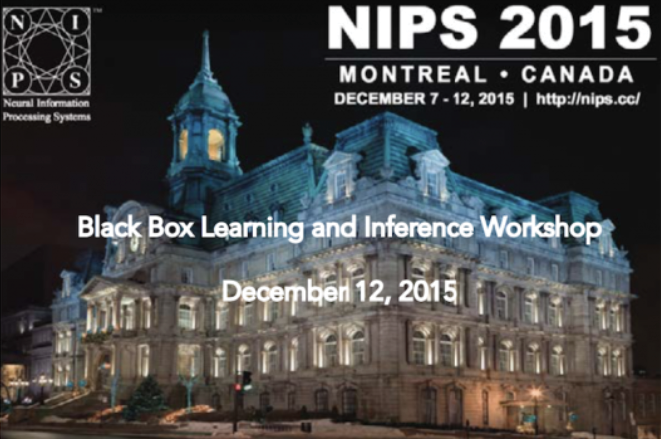
NIPS 2015 Workshop on Black Box Learning and Inference

Dec 12, 2015 - 8:30 am
Image for NIPS 2015 Workshop on Black Box Learning and Inference
Venue:  Palais des congrès de Montréal, Montreal, Canada Address:  1001 Place Jean-Paul-Riopelle, Montréal, QC H2Z 1H5, Canada

Prof. Joshua Tenenbaum (CBMM Research Thrust Leader) and Tejas Kulkarni (CBMM Siemens Graduate Fellow) are helping to organize the NIPS 2015 Workshop on Black Box Learning and Inference.


Overview

Probabilistic models have traditionally co-evolved with tailored algorithms for efficient learning and inference. One of the exciting developments of recent years has been the resurgence of black box methods, which make relatively few assumptions about the model structure, allowing application to broader model families.

In probabilistic programming systems, black box methods have greatly improved the capabilities of inference back ends. Similarly, the design of connectionist models has been simplified by the development of black box frameworks for training arbitrary architectures. These innovations open up opportunities to design new classes of models that smoothly negotiate the transition from low-level features of the data to high-level structured representations that are interpretable and generalize well across examples.

This workshop brings together developers of black box inference technologies, probabilistic programming systems, and connectionist computing frameworks. The goal is to formulate a shared understanding of how black box methods can enable advances in the design of intelligent learning systems. Topics of discussion will include:

  • Black box techniques for gradient ascent, variational inference, Markov chain- and sequential Monte Carlo.
  • Implementation of black box techniques in probabilistic programming systems and computing frameworks for connectionist model families.
  • Models that integrate top-down and bottom-up model representations to perform amortized inference: variational autoencoders, deep latent Gaussian models, restricted Boltzmann machines, neural network based proposals in MCMC.
  • Applications to vision, speech, reinforcement learning, motor control, language learning.

Keynote talks

  • Josh Tenenbaum
  • Geoff Hinton

Research talks

  • Durk Kingma
  • Alp Kucukelbir
  • Jan-Willem van de Meent

Systems spotlights

  • Koray Kavukcuoglu (Torch)
  • Alp Kucukelbir (Stan)
  • Yi Wu (BLOG)
  • Avi Pfeffer (Figaro)
  • Vikash Mansinghka (Venture)
  • Tejas Kulkarni (Picture)

Organizers

News Link: http://www.blackboxworkshop.org/

Organizer:  Joshua Tenenbaum Tejas Dattatraya Kulkarni

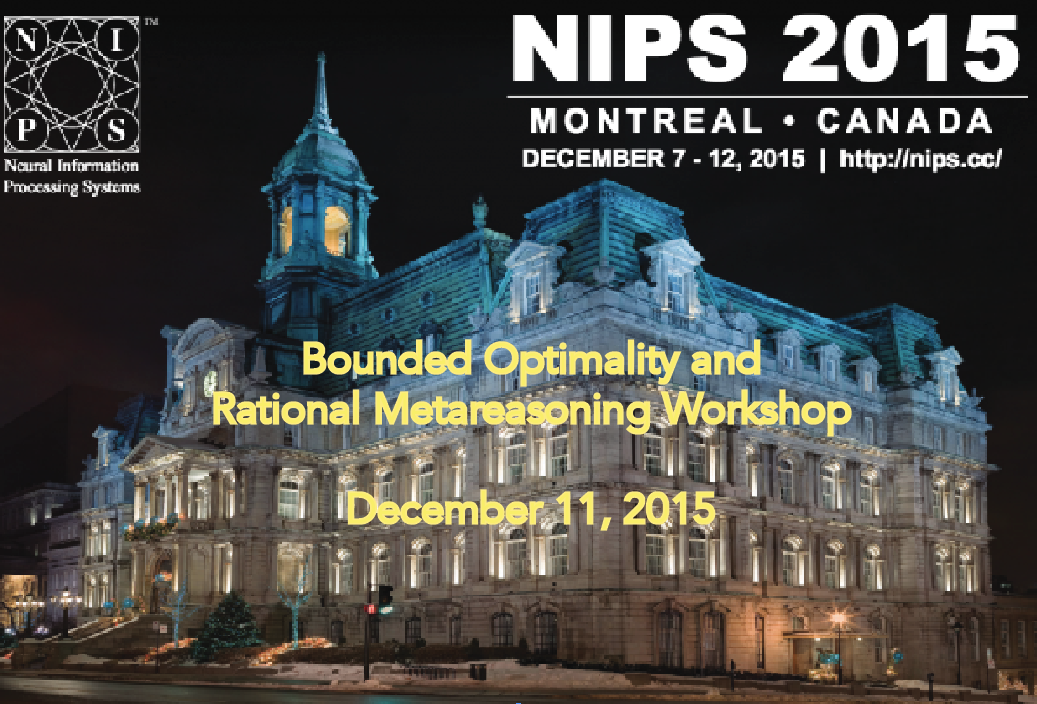
NIPS 2015 Workshop on Bounded Optimality and Rational Metareasoning

Dec 11, 2015 - 8:30 am
Nips
Venue:  Palais des congrès de Montréal, Montreal, Canada Address:  Montreal Convention Center, Room 512bf 1001 Place Jean-Paul-Riopelle, Montréal, QC H2Z 1H5, Canada

Prof. Sam Gershman (CBMM, Harvard) and Prof Noah Goodman (CBMM, Stanford)

We are pleased to announce a NIPS workshop on Bounded Optimality and Rational Metareasoning, which will take place on December 11, 2015, in Montreal, Canada.

This workshop brings together computer scientists working on bounded optimality and metareasoning with psychologists and neuroscientists reverse-engineering the computational principles that make the human brain incredibly resource-efficient. The goal of this workshop is to synthesize these different perspectives on bounded optimality, to promote interdisciplinary interactions and cross-fertilization, and to identify directions for future research.

Tentative schedule: https://sites.google.com/site/boundedoptimalityworkshop/home 

Organizer:  Samuel Gershman Noah Goodman

Pages

Subscribe to No